
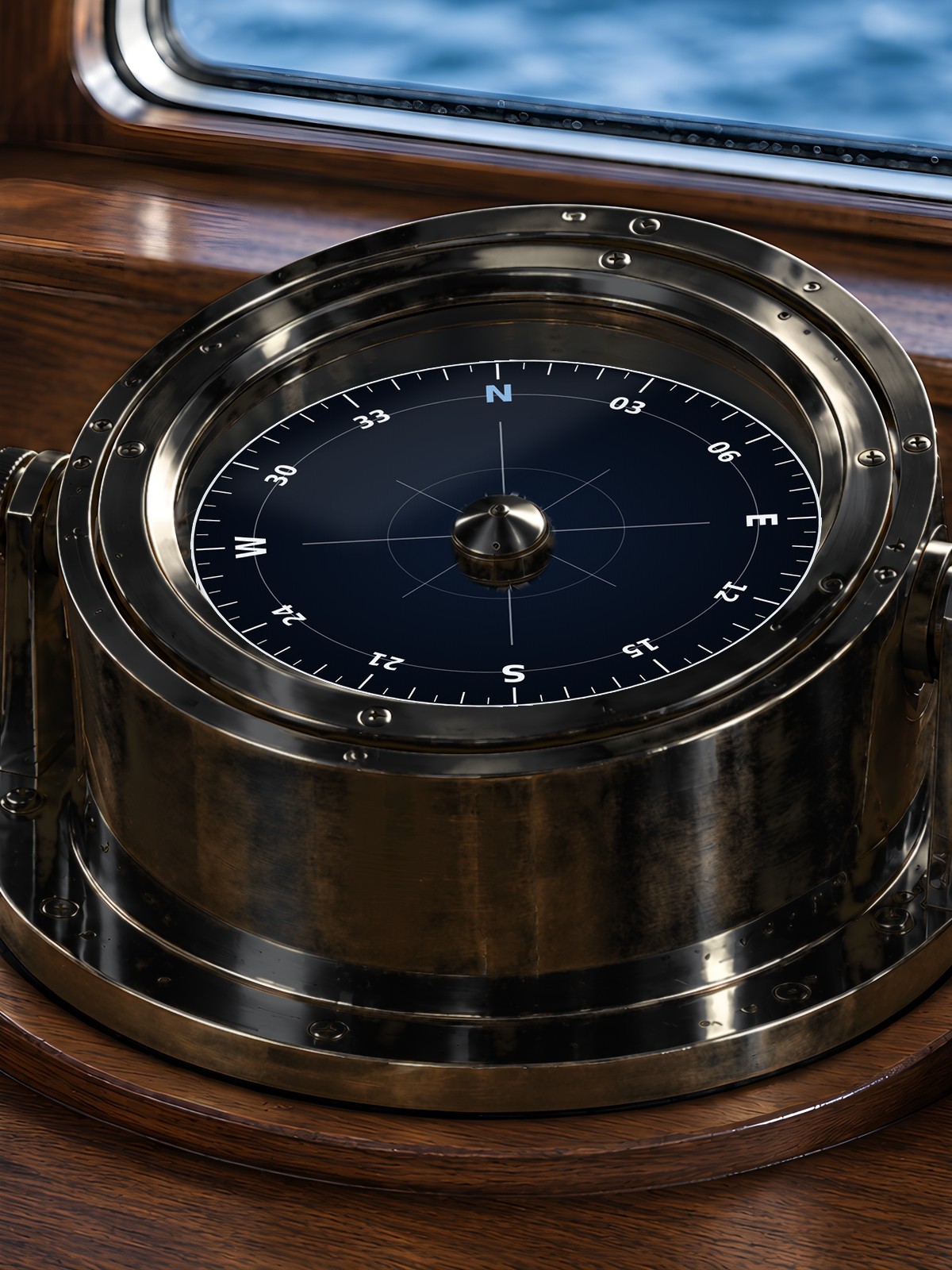
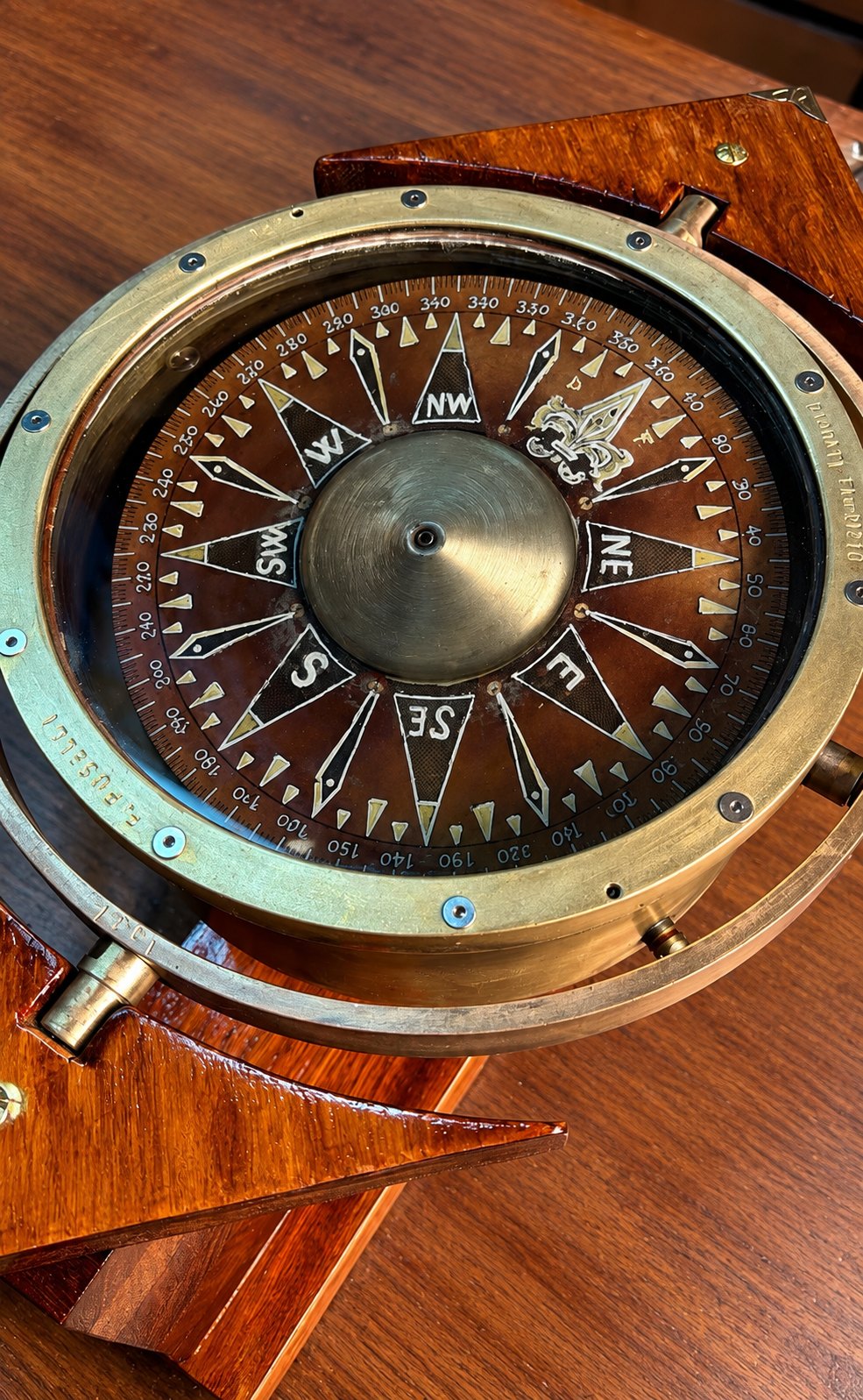
Knowledge and skills in ship’s magnetism characterise the adjustment, checking and overhaul of magnetic compasses.
A magnetised needle, free to rotate in the horizontal plane, tends to point its red end towards magnetic North, which does not coincide with geographic or true North. The marine magnetic compass exploits this property and helps the navigator find their bearings at sea and steer the ship in a given direction.
The presence of ferrous masses on board creates a magnetic field, called the ship’s magnetic field, due to the magnetisation of the various iron parts immersed in the Earth’s magnetic field. As a result of this magnetisation, the compass needle aligns with the resultant of the magnetic forces acting on it: the compass therefore does not indicate magnetic North but another direction, called compass North.
From a magnetic point of view, the iron parts on board are of two types:
Tempered steels, very hard special steels, etc. Immersed for a long time in a magnetic field of constant direction, they magnetise slowly but retain the acquired magnetisation for a long time: they create poles on board that remain fixed for a rather long period.
Homogeneous iron and, in general, all low-carbon irons. Immersed in the Earth’s magnetic field, they magnetise by induction very easily but demagnetise just as easily, acquiring a new magnetisation as the heading of the bow changes with respect to the inducing field: they create poles that continually change position.
The poles present on board due to hard and soft iron can be neutralised by a procedure called adjustment (compensation), aimed at cancelling the deviating forces and, consequently, the deviations: large errors weaken the compass’s directive power towards North.
They are cancelled by permanent magnets placed beneath the compass in the longitudinal and transverse directions.
They are compensated with soft-iron spheres or cylinders placed at the sides of the compass.
Once the adjustment is done, compass swings are carried out: the vessel is placed on various headings and the residual deviation is determined on each, then recorded in the tables next to the relevant heading.
The service also includes preparing and issuing the four-yearly overhaul certificates through specific laboratory tests.